

Blog
Why we show everything we see
HookScreener listens to the order books of nine exchanges and publishes every signal in real time — exact sizes and prices included. Here is why we built a map instead of a feed of predictions, what forty thousand wrongly killed alerts taught us, and why transparency is a strategy, not a gesture.
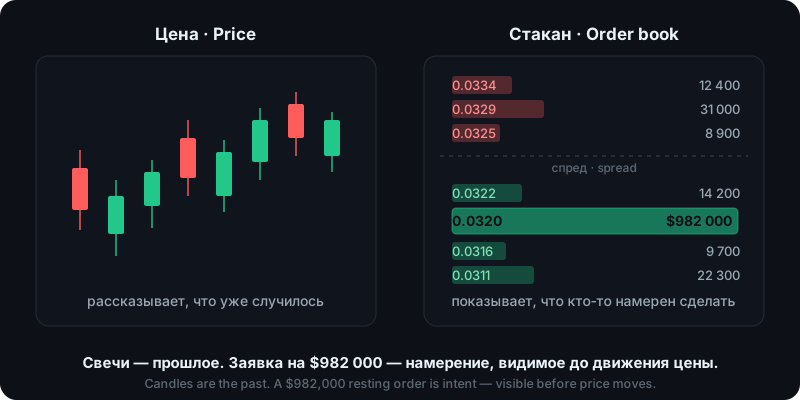
Most crypto services put a narrator between the market and the user. The narrator reads the chart, draws conclusions, and sells them to you: "growth likely," "target is X," "entry signal." We build HookScreener on the opposite conviction: the narrator is unnecessary. The market publishes its own intentions — in the order book, in the trade flow, in how orders appear and vanish. The problem isn't that this information is hidden. The problem is that a human physically cannot watch nine exchanges and nearly ten thousand pairs at once.
That is the problem we solve. We don't "predict the market" — we shorten the distance between an event in the order book and your eyes to a few seconds.
Facts instead of opinions
Every alert we send is a set of measurable facts. A wall of $982,000 at 0.0320, standing for zero minutes, one-minute move 2.74%, nine percent from the spread. Not a single word about what you should do with it. This is deliberate: we don't know your strategy, your risk, your horizon. Anyone who says "buy" to a stranger is either irresponsible or selling something.
This approach costs more. An opinion is easy to invent — whereas catching robotic flow on MEXC meant writing our own decoder for their binary protocol, because the documented one had been switched off years ago. Telling a real wall from a market maker's decoy meant a month of watching order behavior: a real wall gets eaten by trades, a fake one gets quietly pulled. But that work is the product. Facts scale. Opinions don't.
Forty thousand killed alerts
A story we tell about ourselves as a warning. We once decided to filter out market-maker walls with a beautiful, logical heuristic: if the order book looks symmetric on both sides, it's a robot quoting — suppress the signal. We shipped it. The filter killed forty thousand alerts in a row and let precisely zero through. It turned out that a symmetric order book is just... a normal order book of a liquid coin.
Since then we have an iron rule: no filter goes live until it has been replayed against days of recorded data, and it launches in shadow mode first — flagging but not suppressing. Boring? Extremely. But "boring and verified" is exactly what you want from a tool you look at every day. We will keep making mistakes; we have stopped shipping unverified ones.
Why everything is visible now
From the start, the website showed only part of the picture: signals reached the live map, but the exact sizes stayed in a private channel. We recently ended that. Every signal now appears on the map in full — exact size, price, wall age, every field.
The logic is simple, almost arithmetic. The value of an order-book signal lives for minutes: the wall gets pulled, the spike retraces, the robot finishes its series. Hiding something that will be stale in ten minutes is guarding an empty safe. Openness, meanwhile, solves the one problem no marketing can: trust. Nobody believes screenshots of "successful signals," and rightly so. But a live map where events appear in front of you, each verifiable against a chart in the same second, doesn't ask to be believed. You can simply watch it.
The map as a common language
We want the order book to stop being a language for insiders. Liquidity walls, icebergs, spoofing, robotic position building — it all sounds like jargon, yet behind every term is a simple, observable phenomenon. We write about them in the blog, show them on the map in real time, and try to make sure that someone opening the market page for the first time understands where to look within a minute.
There will be more: more exchanges, more signal types, more history per coin. But the direction won't change. We are not an oracle and not a tipster. We are the glass between you and the order book — and our job is to keep that glass as clean as possible.