

Blog
Crypto arbitrage in 2026: why the biggest spreads are fake
We logged 10,212 arbitrage spreads across 16 exchange sources. Above 20%, 95% were untradeable. What makes a spread false, and what a real one looks like.
Open any arbitrage scanner today and the top of the list looks like free money: +880% on OPENAI, +863% on ANTHROPIC, +135% on QNT. Buy on one exchange, sell on the other, keep the difference.
The problem is not that the market is that inefficient. The problem is that the scanner may be comparing something other than what you think.
None of those three was tradeable. We know because our own scanner found all three on the same afternoon and blocked every one of them. Over 25.7 hours it logged 10,212 spread episodes across 16 exchange sources, and the pattern was consistent enough to put in one sentence: the bigger the spread, the less likely it is real.
This is what we measured — what makes a spread false, what a real one looks like, and how to check any spread before you trade it.
The short answer
Crypto arbitrage still exists in 2026, but a real spread is small, short and shallow. In our data the median peak of the net spread was 0.55% after fees, half of spreads closed within a minute, and the median spread held about $2,100 of size. Spreads above 20% were almost never executable: 77 of 81 were blocked, nearly all because the two venues were not trading the same asset.
How we measured
Every number here comes from our production scanner, not a backtest.
| Parameter | Value |
|---|---|
| Window | 25.7 hours, 25–26 September 2026 |
| Spread episodes | 10,212 |
| Sources | 16 (spot and futures of 10 exchanges) |
| Size each spread is priced at | $1,000 per leg, filled through the real order book |
| What "net" means | after taker fees on both legs |
| Recalculation | every 3–5 seconds |
An episode is one spread from the moment it crosses the threshold to the moment it falls back. A blocked episode is one the scanner refused to present as tradeable, for one of three reasons described below. One caveat worth stating up front: a day is a short window, and a different week will give different absolute numbers. The shape of the result is what we would expect to hold.
What crypto arbitrage is, and the routes we saw
Arbitrage means buying an asset where it is cheaper and selling the same asset where it is dearer, at the same moment, so the price difference is locked in without betting on direction. The key words are same asset and same moment — both turn out to be where most spreads fail.
Four routes appear in our data, and their mix says a lot about this year's market:
- Futures → futures (4,391 episodes, 43%) — long one perpetual, short another. The most common route, largely because 2026 has far more perpetual venues, including exchanges like HyperLiquid and Aster.
- Spot → futures and futures → spot (4,882 combined, 48%) — buy the coin and short its perpetual, or the reverse. The coin never has to move between exchanges.
- Spot → spot (939, 9%) — the textbook version. Buy on one exchange, sell on another. It is the only route that usually needs the coin transferred, which is why it is the one most often stopped by closed withdrawals.
What we found: the bigger the spread, the more likely it is false
Two things stand out.
Below 2%, roughly a quarter to a third of spreads were blocked, and the red segment dominates: a stale order book. Above 5% the picture flips — the amber segment takes over, and it means a different asset under the same ticker. And above 20%, almost every spread turned out to be non-executable:
75 of the 77 because the two venues could not be confirmed as trading the same asset.
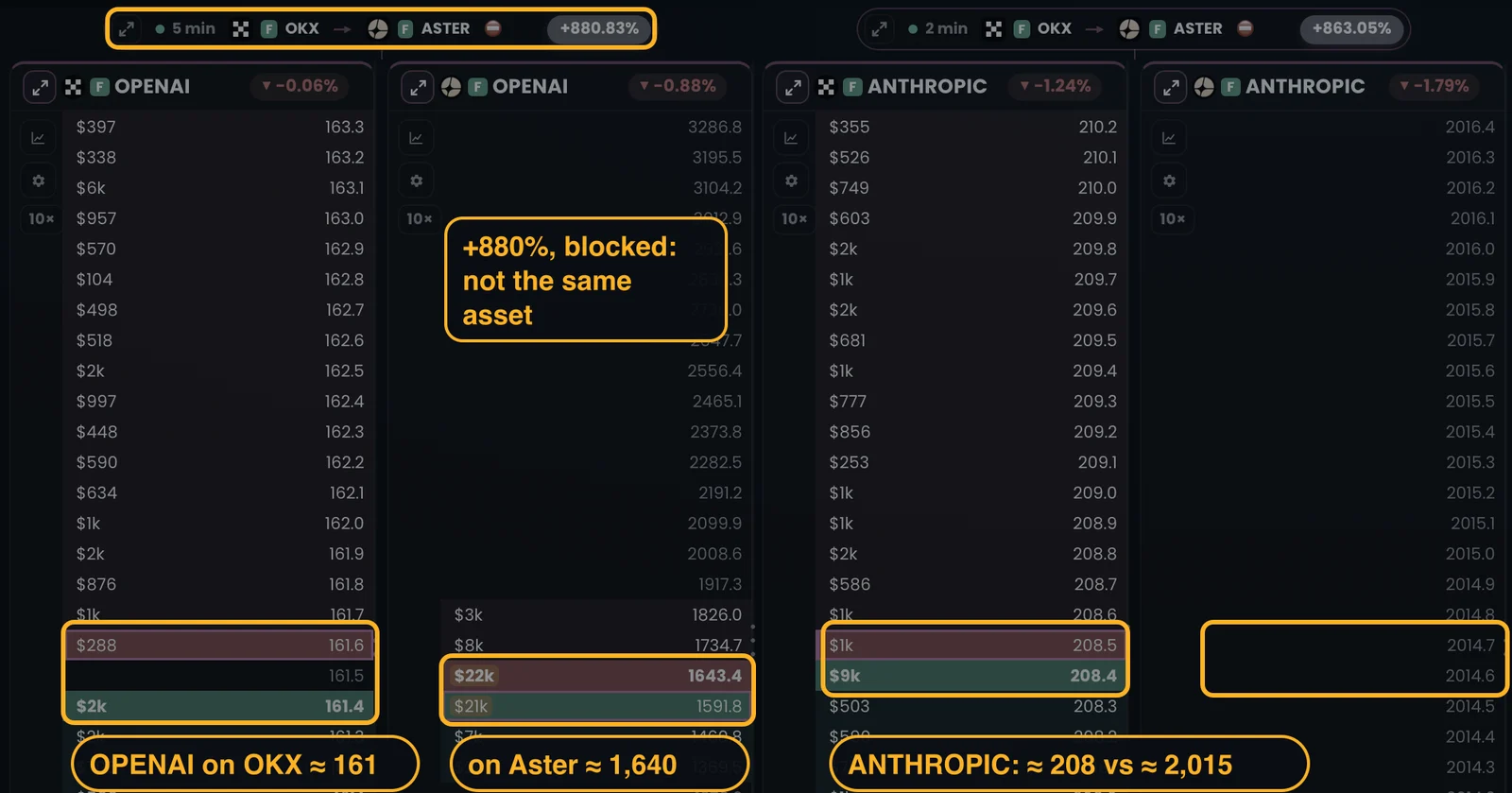
Here is what that looks like on the screen. These are the pairs behind the three biggest numbers of the afternoon:
The four traps behind false spreads
1. One of the order books stopped updating
The most common trap by far: 2,343 of the day's episodes were blocked because one venue's book had gone stale. A spread is calculated from two books at the same instant. If one of them has not updated in several seconds, you are comparing a live price with a snapshot of the past, and the "spread" is simply the market having moved on one side only.
It is also the trap you cannot see by looking at two prices. Both look like numbers; only the timestamps tell you one of them is old. Our scanner blocks a pair once the two books drift more than 5 seconds apart and labels it on the card:

2. The same ticker is a different asset
A ticker is a label, not an identity. In our data, 33 assets traded under a colliding ticker across 628 exchange routes. Two versions of this show up:
- Different contracts on derivatives venues. 2026 brought perpetuals on things that were never crypto tokens — tokenized stocks and contracts named after private companies. The OPENAI and ANTHROPIC pairs above are this case: the price itself is ten times apart.
- Different tokens on spot. On 22 September we measured a +13.3% "spread" on AI: one exchange's AI token was a BSC contract starting
0xBDA0…, the other's an ERC-20 contract starting0x4d70…. Same three letters, two unrelated coins.
Above 5% net, our scanner checks the token's contract address where exchanges publish it. If the two do not match, or the match cannot be confirmed, the pair is blocked.
3. You cannot move the coin
On 22 September ZIL showed a stable +7.6% net between Gate and KuCoin for 42 seconds, with about $22,000 executable. It looked like the best trade on the board. Both exchanges were reporting deposits and withdrawals of ZIL as disabled.
That is not a coincidence. A spread often persists precisely because nobody can close it. If a route needs the coin moved from one exchange to the other and either door is shut, the spread is a picture of a gap you cannot walk through. It blocked 119 episodes in our window.
The same coin can be fine on a different route — you will see it in the next section: ZIL again, but from MEXC spot to OKX futures, where nothing has to be transferred.
4. Funding works against the position
Futures legs pay or receive funding every few hours. For 531 episodes the funding ran against the position the spread implies. It does not make the spread untradeable at the moment of entry — two fills happen at the prices they happen at — but if you hold through the next payment, funding comes out of the profit. That is why we show it separately from net rather than folding it in: it depends on how long you hold, which a single number cannot know.
In short: what the scanner shows and what is behind it
| What the scanner shows | What is actually happening |
|---|---|
| +880% | Different assets under one ticker (OPENAI, OKX → Aster: prices ten times apart) |
| +7.6% | Deposits and withdrawals of the coin are closed (ZIL, Gate → KuCoin) |
| +2.9% | The best level is too small: MEXC's ask held $8 (ZIL, MEXC → OKX) |
| +1.8% | The real spread of the same pair at $1,000 after fees |
| +0.55% | The median peak net spread of the day — what a typical real opportunity looks like |
What a real spread looks like
Take away the blocked episodes and a very different picture is left.
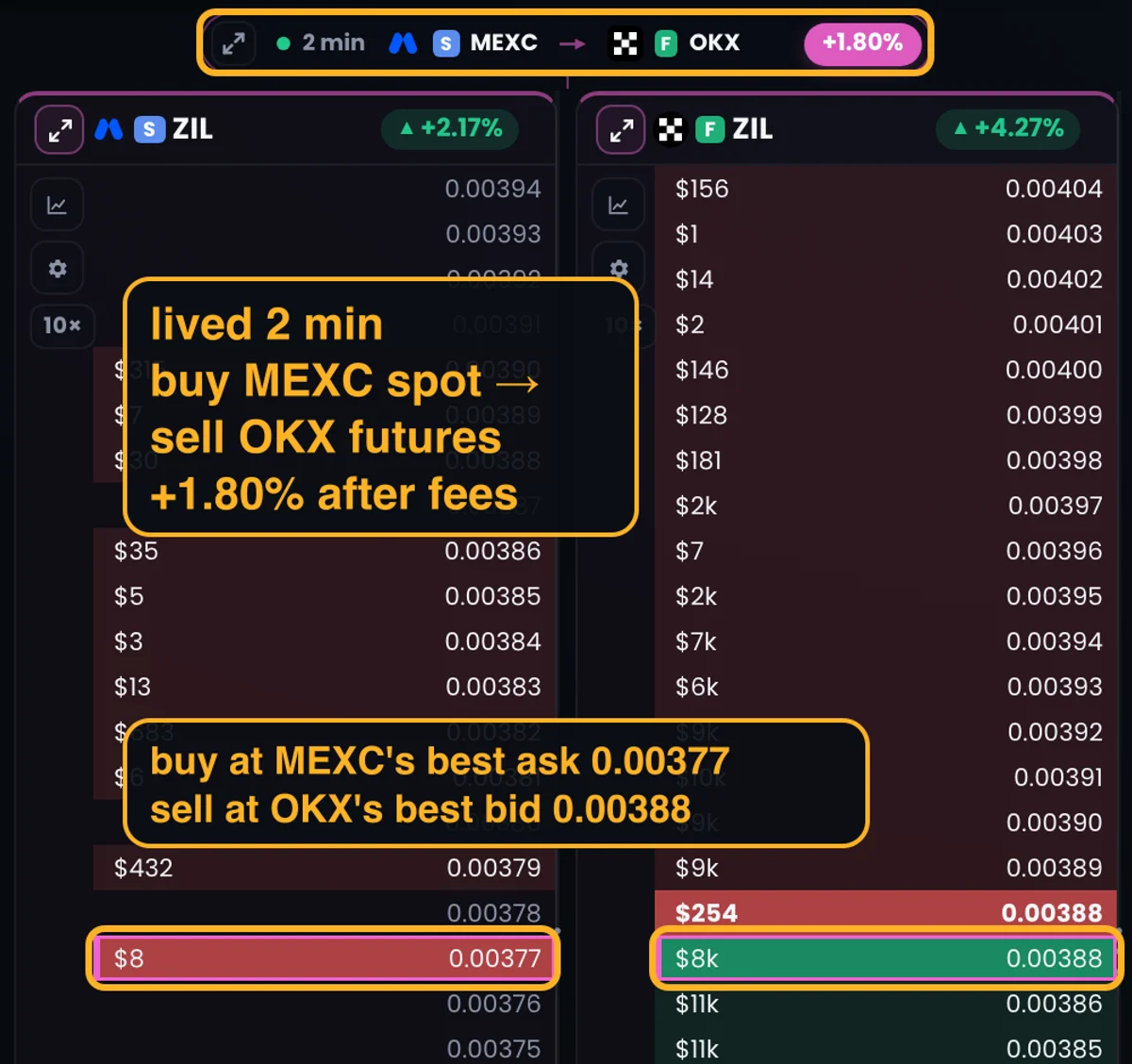
- Gap between the best prices +2.9%
- Real fill at $1,000 after fees +1.80%
- Why: MEXC's best ask of 0.00377 held only $8 — the rest had to be bought further up the book, and then both legs' fees came off
The numbers for real spreads across the whole window:
- Size of the spread: median peak 0.55% net of fees; 90% peaked under 1.43%. For comparison, Bybit's own arbitrage guide puts typical margins at 0.05–0.3% after basic fees — the same order of magnitude.
- How much it holds: the median real spread stayed above the threshold up to about $2,100; 90% held less than $6,400. This is the number most scanners do not show, and it decides whether an opportunity is worth your time.
- What fees take: on the median real spread, fees ate 27% of the gross difference.
- The top-of-book illusion: the gap between best prices overstated the real net by more than a third — the median real net was 63% of the top-of-book gap.
Half of real spreads were gone within a minute, and 30% within 15 seconds. At the other end, a third stayed open for more than an hour. A spread that lingers is worth one extra question before you act on it: why has nobody closed it yet? Sometimes the answer is that it is small. Sometimes it is one of the four traps above.
How to check any arbitrage spread before you trade it
The same checks work whatever scanner you use:
- Are both order books live? Compare the time each price was last updated, not just the prices.
- Is it the same asset? Match the contract address, or at least the network, on both venues. A 10× price difference is an instant no.
- Does the route need a transfer? If it does, check that deposits and withdrawals are open on both exchanges for that exact network.
- What is the price at your size? Walk the order book for the amount you intend to trade. The best price may hold a few dollars.
- What is left after fees? Subtract taker fees on both legs, plus withdrawal fees if the coin moves.
- Will you hold a futures leg through funding? If so, check which side pays.
- How much will it take? Find the size at which the spread stops clearing your threshold. That is your real opportunity.
Where HookScreener fits
Those seven checks are not only a checklist for the reader. Our arbitrage alert is built around them, because a scanner that shows +880% at the top of its list has already failed at its only job. The difference shows on a single number:
- +880%
- shows an opportunity
- +880%
- asset check
- book freshness
- liquidity
- fees
- transfer availability
- real executable spread
That is why we rank opportunities not by the biggest number but by the net spread at a real fill — and a blocked pair never sits above an available one.
Every pair on our board is priced by filling $1,000 through both real order books, after taker fees on both legs, rounded to each exchange's lot size where it publishes one. It shows how long the spread has lived, the largest size it still holds and which book runs out first. Pairs with a stale book, an unconfirmed asset, or a closed transfer on a route that needs one are blocked — and blocked pairs are hidden by default, so the top of the list is the best real spread, not the biggest false one. Funding is shown separately, as a warning, when it works against the position. Each pair opens as two live order books side by side, so you can see the depth behind the number yourself.
What it does not do, plainly:
- It does not trade both legs for you. It finds and prices the spread; execution is yours.
- Speed. It recalculates every 3–5 seconds. With 30% of real spreads gone within 15 seconds, some will close before anyone can act on them.
- Coverage. 16 sources across 10 exchanges, not every venue that exists. Kraken spot is currently excluded: its books reach us too late to price a spread honestly.
- Identity checks depend on exchanges publishing contract addresses; where they do not, a large spread stays blocked rather than being passed as real.
Open the HookScreener arbitrage board — no sign-up needed. It shows both exchanges' live order books, how long the spread has lived and how much size it holds. Click a pair's percentage to see the fees, funding and the reason an opportunity is blocked. Blocked pairs are hidden by default; the second link opens spreads above 5% together with the blocked ones — the very spreads this article is about.
FAQ
Is crypto arbitrage still profitable in 2026? It exists, but the real opportunities are small. In our data the median peak net spread was 0.55% after fees, the median spread held about $2,100 of size, and half closed within a minute. It rewards speed, low fees and capital already sitting on both exchanges.
Why can't I just buy on the cheap exchange and sell on the expensive one? Because the number in a scanner is usually the gap between best prices, not what you will get. The best level may hold a few dollars, like MEXC's ZIL ask in the example above, so the rest of your size is bought higher — and both legs' fees still come off. On top of that come the traps in this article: a different asset may trade under the same ticker, one exchange's book may be stale, and the coin transfer may be closed.
Why can an arbitrage spread exist for several minutes and still be untradeable? Because a long-lived spread tells you not that it is available, but that nobody has closed it. The ZIL spread between Gate and KuCoin persisted precisely because deposits and withdrawals were closed on both exchanges. A gap between two different assets under one ticker does not close by itself either: there is nothing to converge. That is why we block a pair for a reason, not for its age.
Why do scanners show spreads of 100% or more? Almost always because the two venues are not trading the same thing. In our window, 77 of 81 spreads above 20% were blocked, 75 of them because the asset could not be confirmed as identical — a different contract or a different token under one ticker.
What is spot–futures arbitrage? Buying a coin on the spot market and shorting its perpetual future (or the reverse). Because you hold one side on each market, the coin never has to be transferred between exchanges — which removes the risk of closed deposits or withdrawals. Funding payments on the futures leg become the thing to watch instead.
How much money do I need for crypto arbitrage? Less than people assume, and more capital does not help much. The median real spread in our data only held about $2,100 before it stopped being profitable. What matters more is having balances ready on both exchanges, because there is rarely time to transfer funds after a spread appears.
How fast do arbitrage opportunities disappear? Half of the real spreads we logged closed within a minute, and 30% within 15 seconds. A third stayed open longer than an hour — which is worth treating as a question, not a gift.
Is crypto arbitrage legal? Buying on one exchange and selling on another is ordinary trading. The rules that matter are each exchange's terms of service and the regulations in your country, so check both before trading across venues.